

 MECHANICS
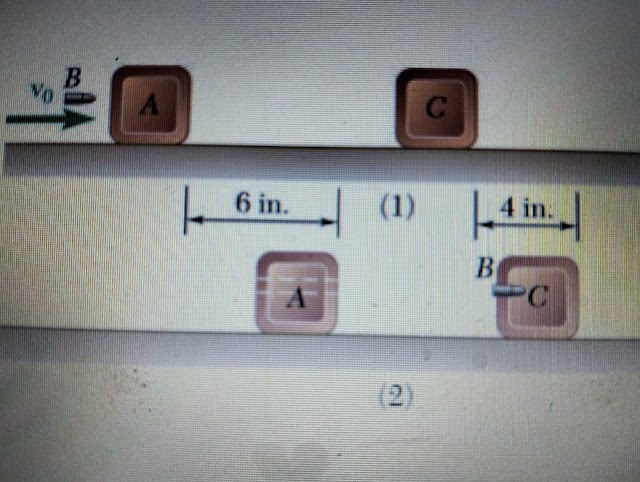
Bullet B weighs 0.5 oz and blocks A and C both weigh 3 lb. The coefficient of friction between the blocks and the plane is k 0.25. Initially the bullet is moving at v0 and blocks A and C are at rest (Figure 1). After the bullet passes through A it becomes embedded in block C and all three objects come to stop in the positions shown (Figure 2). Determine the initial speed of the bullet v0.
Bullet B weighs 0.5 oz and blocks A and C both weigh 3 lb. The coefficient of friction between the blocks and the plane is 0.25. Initially the bu…
Read more MECHANICS
At an intersection car B was traveling south and car A was traveling 30° north of east when they slammed into each other. Upon investigation it was found that after the crash the two cars got stuck and skidded off at an angle of 10° north of east. Each driver claimed that he was going at the speed limit of 50 km/h and that he tried to slow down but couldn’t avoid the crash because the other driver was going a lot faster. Knowing that the masses of cars A and B were 1500 kg and 1200 kg, respectively, determine (a) which car was going faster, (b) the speed of the faster of the two cars if the slower car was traveling at the speed limit
At an intersection car B was traveling south and car A was traveling 30° north of east when they slammed into each other. Upon investigation it was…
Read more MECHANICS
The triple jump is a track-and-field event in which an athlete gets a running start and tries to leap as far as he can with a hop, step, and jump. Shown in the figure is the initial hop of the athlete. Assuming that he approaches the takeoff line from the left with a horizontal velocity of 10 m/s, remains in contact with the ground for 0.18 s, and takes off at a 50° angle with a velocity of 12 m/s, determine the vertical component of the average impulsive force exerted by the ground on his foot. Give your answer in terms of the weight W of the athlete.
The triple jump is a track-and-field event in which an athlete gets a running start and tries to leap as far as he can with a hop, step, and jump. …
Read more MECHANICS
A baseball player catching a ball can soften the impact by pulling his hand back. Assuming that a 5-oz ball reaches his glove at 90 mi/h and that the player pulls his hand back during the impact at an average speed of 30 ft/s over a distance of 6 in., bringing the ball to a stop, determine the average impulsive force exerted on the player’s hand.
A baseball player catching a ball can soften the impact by pulling his hand back. Assuming that a 5-oz ball reaches his glove at 90 mi/h and that t…
Read more MECHANICS
sailboat weighing 980 lb with its occupants is running down wind at 8 mi/h when its spinnaker is raised to increase its speed. Determine the net force provided by the spinnaker over the 10-s interval that it takes for the boat to reach a speed of 12 mi/h.
sailboat weighing 980 lb with its occupants is running down wind at 8 mi/h when its spinnaker is raised to increase its speed. Determine the net fo…
Read more MECHANICS
A 3-kg block rests on top of a 2-kg block supported by, but not attached to, a spring of constant 40 N/m. The upper block is suddenly removed. Determine (a) the maximum speed reached by the 2-kg block, (b) the maximum height reached by the 2-kg block.
A 3-kg block rests on top of a 2-kg block supported by, but not attached to, a spring of constant 40 N/m. The upper block is suddenly removed. Dete…
Read more MECHANICS
A 2000-kg automobile starts from rest at point A on a 6o incline and coasts through a distance of 150 m to point B. The brakes are then applied, causing the automobile to come to a stop at point C, 20 m from B. Knowing that slipping is impending during the braking period and neglecting air resistance and rolling resistance, determine (a) the speed of the automobile at point B, (b) the coefficient of static friction between the tires and the road.
A 2000-kg automobile starts from rest at point A on a 6 o incline and coasts through a distance of 150 m to point B . The brakes are then applied, ca…
Read more

